


Beyond the Basics: How Organizations Can Strengthen Their Background Screening Program
9 min read
Published
Apr 24, 2026

Building a safe, trusted workforce is one of the most important responsibilities an organization carries. Most hiring teams rely on core background screening components like criminal searches, employment and education verifications, and drug testing, to name a few.
These foundational steps matter, but as hiring demands evolve, many organizations are asking what lies beyond the basics to deliver a clearer, more confident view of candidates without sacrificing speed to hire.
In our recent webinar Inside 2026: Hiring, Compliance, & Screening Trends Shaping the Year Ahead, we shared how employers are upgrading their hiring workflows by prioritizing new screening tools. When thoughtfully integrated, these tools help hiring teams move faster and smarter, bringing greater clarity and peace of mind without adding unnecessary complexity.
Below, we explore the most impactful ways to elevate your background screening program, improving both insight and efficiency while giving hiring teams the support they need to make well‑informed decisions with confidence.
Alias Name Searches: Helping You See the Full Story
Candidates often have more than one name in their history, including nicknames, maiden names, former married names, shortened names, or legal name changes. And that means important details can be tied to names a candidate no longer uses. Without searching alias names, employers may unknowingly miss valuable information tied to a candidate’s past identity.
Why are alias names treated as an optional enhancement rather than a standard component of criminal background checks? Criminal records are primarily name-indexed, not identity-indexed. Most U.S. criminal court records are stored and searched by exact name matching, often combined with date of birth (DOB) or partial DOB. Courts generally do not retroactively update records when someone legally changes their name, and searching each possible name variation requires a separate search in each jurisdiction.
Incorporating alias name searches into your background screening process is a best practice for background check comprehensiveness and can potentially increase the number of records found. Asurint automatically identifies additional names through social security number (SSN) trace, without relying solely on names disclosed by the candidate.
When organizations include alias searches, we find that they can uncover 15–20% more records on average1, a meaningful difference for any team striving to hire with confidence.

This is one small but powerful step that makes the entire process more complete and gives employers clearer insight from the very start.
Social Media Screening: What Public Online Behavior Can Reveal
With so much information readily available online, hiring teams may feel tempted to search a candidate’s name during the screening process. 85% of employers who used social media to screen on their own have found content that caused them to not hire a candidate.
However, screening a candidate’s social media on your own opens an employer to the risk of encountering protected class information, such as religion, disability status, or pregnancy, that could inadvertently influence hiring decisions, ultimately exposing you to legal risk.
But a candidate’s online behavior can reveal risk indicators that wouldn’t show up in traditional background checks, including:
- Threats or harassment
- Intolerance or hate speech
- Violent behavior
- Sexual references
- Criminal activity
- Illicit drug use
- Trolling or disruptive social media behavior
While the risks of improper social media screening are real, so are the risks of ignoring online behavior altogether. In addition to negligent hiring risks, hiring someone whose online conduct contradicts your company’s values can also have serious consequences for workplace culture, brand reputation, and employee trust.
That’s why it’s necessary to look for an FCRA-compliant social media background screening service that can provide a comprehensive search of publicly available social media content to identify behaviors that align or misalign with your company’s values and policies. Fama, an innovator in social media screening, is integrated into the Asurint platform, enabling a comprehensive search of publicly available social media content, including social media posts, web search results, and more.

Continuous Monitoring: Staying Informed After Day One
A background check provides a reliable snapshot of a candidate’s history during the hiring process, helping organizations establish a baseline of trust and meet compliance requirements. However, like any point-in-time assessment, traditional background checks have a limitation: they become outdated the moment they're completed. A clear background check report on day one doesn't tell an employer anything about what happens after Day One.
Continuous monitoring is an ongoing process that helps employers stay aware of new risks that can arise after an employee is hired. Instead of relying only on a one-time background check or annual rescreening, continuous monitoring uses automated tools and data sources to alert employers when a new record appears.
Real-time monitoring goes beyond a one-time, fixed background check:
- Lower potential risk: Lacking timely access to the information you need to assess whether an employee continues to meet your organization’s standards can put your organization at risk.
- Avoid unnecessary fines and/or reputational damage: Learning about unlawful activity and license changes in near real-time can help you quickly identify and mitigate potential reputational and financial risks and negligent retention claims.
- Minimize administrative burden: Shifting from rescreening to ongoing monitoring reduces costly resources used for manual ordering and reporting.
Asurint’s continuous monitoring includes MVR monitoring and healthcare license monitoring to help employers manage ongoing risks post-hire. It’s a proactive way to prioritize safety and mitigate risk while supporting employees and protecting your team.
Federal Criminal Searches: Expanding Your View Beyond County and State Records
Many employers rely on county and state criminal searches, which are important, but it doesn’t provide the whole story. Federal criminal records are maintained by state county criminal records. Serious offenses that are prosecuted under federal law don’t appear in county court records, including:
- Tax evasion
- Cybercrimes
- Embezzlement
- Kidnapping
- Bank robbery
- Mail fraud
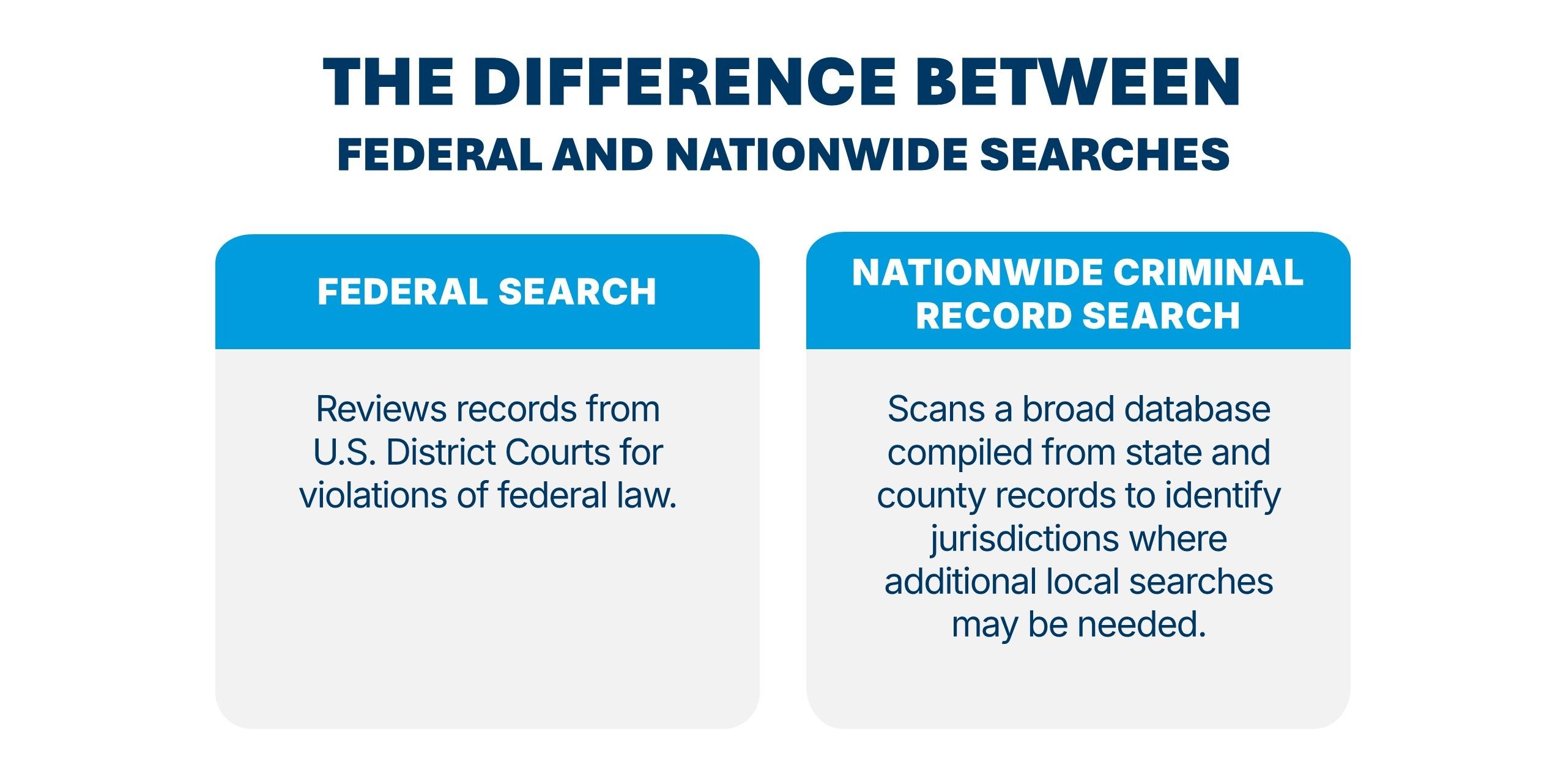
A federal criminal record search is often mistaken for a nationwide search, but the two are very different:
- A federal search reviews records from U.S. District Courts for violations of federal law.
- A nationwide criminal record search scans a broad database compiled from state and county records to identify jurisdictions where additional local searches may be needed.
Conducting a federal criminal search helps ensure you aren’t left with blind spots. By expanding the scope of background screening, this broader visibility supports safer, more informed hiring decisions.
Global Sanctions & Watchlist Screening: Making Compliance Easier to Navigate
Global sanctions and watchlist screening is the process of reviewing individuals against international government and regulatory lists that identify sanctioned, restricted, or high‑risk parties. These lists are maintained by authorities such as the U.S. Office of Foreign Assets Control (OFAC), the United Nations (UN), and the European Union (EU), and often include individuals or entities connected to terrorism, financial crime, human rights violations, or other prohibited activities.
For employers, this type of screening plays an important role in compliance and risk management, especially for roles involving finance, sensitive data, or international operations. Sanctions and watchlist screening helps organizations:
- Prevent violations of domestic and international laws
- Reduce legal, financial, and reputational risk
- Demonstrate due diligence in the hiring process
- Make informed hiring decisions in regulated or global environments
Including global sanctions and watchlist checks as part of a background screening program helps employers operate responsibly while protecting their workforce, customers, and business partners.
Adjudication Assistance: Bringing Consistency and Fairness to Decision-Making
Reviewing background results can be stressful, especially when hiring timelines are tight. Many teams worry about being fair, consistent, and compliant, all at once.
Automated candidate adjudication streamlines how hiring teams review background check results. Asurint’s automated adjudication technology, IQ Assist™, applies role‑specific criteria, such as offense type, severity, and recency, to automatically flag the records that need review.
For employers and hiring teams, this automation reduces time‑to‑hire while supporting fair, auditable, and scalable decision‑making. Key benefits include:
- Faster reviews by focusing on actionable results
- Consistent adjudication aligned to job requirements
- Reduced compliance risk through standardized logic
- Improved efficiency for high‑volume hiring
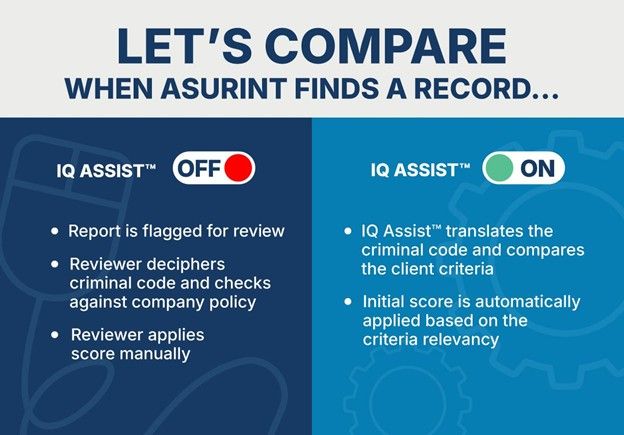
For staffing agencies specifically, Asurint’s IQ Assign™ works with IQ Assist™ service to deliver a smarter, multi-client matching engine. How?
- After a background check, IQ Assist™ applies adjudication logic across each client’s unique criteria
- IQ Assign™ then compares the initial scored report across all unique client-specific rulesets and identifies alternative placement opportunities where the candidate qualifies
This is a game‑changer for staffing firms, enabling them to fill roles faster, reduce candidate downtime, and improve the overall candidate experience.
Enabling Confident Hiring Decisions with a Trusted Background Screening Partner
Enhancing a background screening program is about building confidence in your hiring decisions and ensuring your team has reliable, consistent information to support them. As hiring risks, compliance requirements, and workplace expectations continue to evolve, many organizations should start evaluating additional screening tools that can provide broader visibility, as well as:
- Strengthening workplace safety
- Reducing risk and uncertainty
- Staying compliant with evolving regulations
- Improving hiring accuracy
- Protecting their people and brand
However, it’s important to approach any program change thoughtfully. Organizations should always consult with their legal or compliance teams before modifying their background screening program to ensure alignment with applicable laws and regulations.
At Asurint, our goal is simple: to be the most supportive, transparent, and human partner you have in the background screening process. We’re here to help you feel confident in every hire, every time. Because behind every job is a person who matters.
Learn more about Asurint’s background screening solutions.
Sources: Asurint Source 2026
Disclaimer: This content is provided for informational and educational purposes only and is not intended to constitute legal advice. It reflects general industry insights and best practices to support discussion and awareness. Organizations should consult with their legal, compliance, or other professional advisors before making changes to their background screening programs to ensure compliance with applicable laws and regulations.
You might also like

5 Golden Rules for Property Operators
The following five principles reflect what effective, modern tenant screening looks like today and how property teams can protect their assets while meeting evolving expectations.

3 Drug Screening Assumptions Employers Need to Revisit
During our recent webinar, "Can You Spot the Lie? The Employer's Drug Testing Reality Check," three themes stood out as particularly important for employers evaluating or updating their drug testing programs.

Social Media Screening: Here's What Employers Need to Know
Social media screening is gaining traction in hiring, but understanding the facts behind the process is key to making informed, compliant decisions.