


3 Drug Screening Assumptions Employers Need to Revisit
5 min read
Published
Sep 21, 2026

During our recent webinar, "Can You Spot the Lie? The Employer's Drug Testing Reality Check," Asurint's General Counsel, Vince Pascarella, and Drug & Health Screening Solutions Engineer, Emily Steiner, challenged attendees to separate fact from fiction through real-world scenarios and interactive polling.
While the discussion covered a wide range of topics, three themes stood out as particularly important for employers evaluating or updating their drug testing programs. Below are the key takeaways from the session.
Oral Fluid Testing Is Complementing, Not Replacing Urine Testing
One of the webinar's most popular polling questions asked attendees whether oral fluid and urine testing produce identical detection windows and are interchangeable in all circumstances.
"The biggest difference between urine testing and oral fluid testing is the detection window,” says Emily. “Oral fluid generally gives us a more recent use window, while urine provides a longer historical window.”
When comparing oral fluid and urine testing, employers should view each specimen type as providing a different snapshot:
- Unlike urine collections, oral fluid testing does not require a specialized restroom or present the challenges associated with obtaining a urine specimen on demand. Collections can be directly observed without creating the same privacy concerns, helping reduce opportunities for substitution or adulteration.
- For remote employees, geographically dispersed workforces, after-hours testing situations, or post-accident scenarios where transportation to a collection site may be difficult, oral fluid collections can simplify logistics and improve the candidate experience.
However, Emily cautioned attendees against viewing oral fluid as a solution to every collection integrity challenge: “No specimen anywhere, ever, is a magical anti-cheating force field. Oral fluid does make certain forms of substitution and adulteration more difficult because the collection is observed, but more difficult is not the same thing as impossible.”
The best testing methodology depends on the purpose of the test, workforce needs, operational realities, and regulatory requirements.
A Workplace Accident Does Not Automatically Create Reasonable Suspicion
One of the webinar's interesting scenarios seemed straightforward at first glance:
- An employee arrives at work, unknowingly already selected through the company's random drug testing program.
- Before they are notified of that selection, they accidentally back a forklift into a storage rack, causing property damage but no injuries.
When attendees were asked which testing type would not be appropriate in the scenario, 59% selected either post-accident testing or random testing, highlighting a common misconception about reasonable suspicion testing.
Emily Steiner weighed in on why employers shouldn’t assume an accident automatically creates reasonable suspicion: “Reasonable suspicion should be grounded in specific contemporaneous observations, such as slurred or slow speech, stumbling, or an odor of alcohol or another substance. Those are observable behaviors. Hitting the rack alone does not establish that the employee may be reasonably suspected to be impaired.”
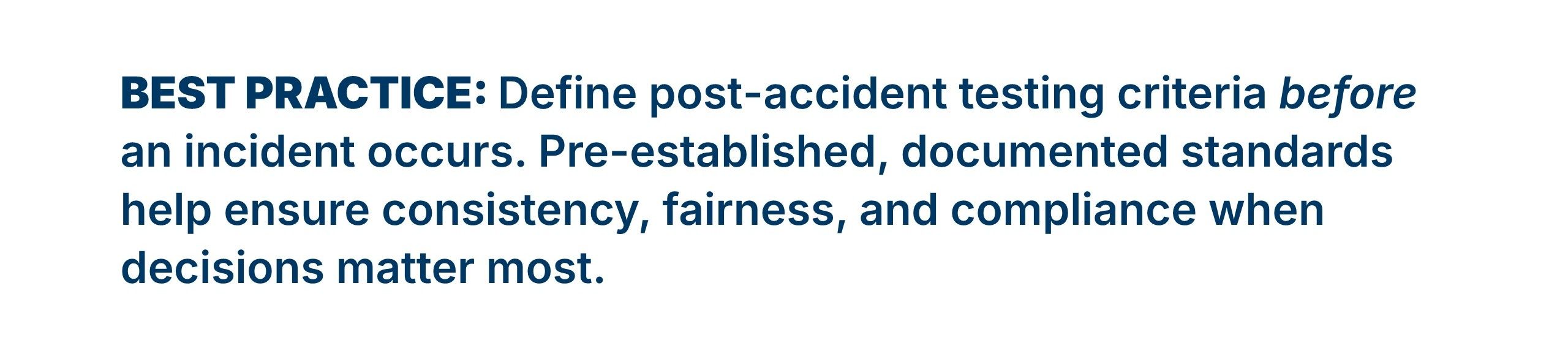
The discussion also highlighted an important policy consideration: employers should define post-accident testing criteria before an incident occurs. Whether testing is triggered by a random selection, property damage, injury, vehicle accidents, or DOT-specific requirements, those standards should already be documented and consistently applied.
A bigger takeaway for employers is that successful drug screening programs depend on preparation rather than reaction. When managers understand the differences between random testing, post-accident testing, and reasonable suspicion testing, organizations are better positioned to make defensible decisions during stressful situations.
The Standard 5-Panel Drug Test May Not Be Telling You the Whole Story
For many employers, the 5-panel drug test is considered the default option. It's familiar, widely used, and often viewed as the industry standard.
But one of the webinar's most eye-opening discussions challenged attendees to rethink exactly what the standard 5-panel was originally designed to do.
Vince explained that the traditional 5-panel, which was created back in the 1980s based on prevalence of use at that time, still screens for:
- Marijuana (THC)
- Amphetamines
- Cocaine
- Opiates
- Phencyclidine (PCP)
However, substances excluded from a standard 5-panel, but commonly included in expanded panels (including benzodiazepines, certain opioids, barbiturates, and some types of MDMA), have reported positivity rates that rival or exceed those of some drugs included in the standard 5-panel. For example, according to Quest Diagnostics Drug Testing Index Report, benzodiazepines have a 0.34% positivity rate and opioids have a .29% positivity rate, compared to cocaine at 0.24%.
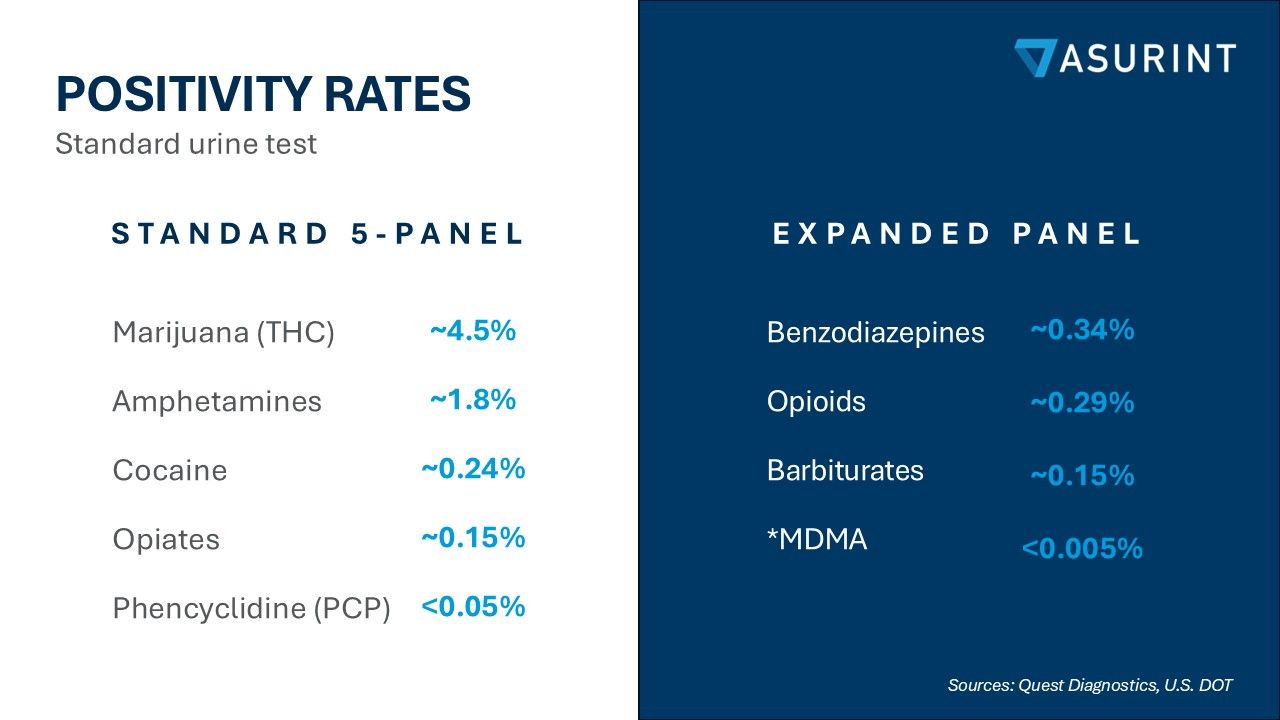
As workplace risks, prescription drug usage, and substance abuse trends have evolved over the past 40 years, employers are increasingly asking whether a standard 5-panel drug test still aligns with their organization's needs.
That doesn't necessarily mean every employer should move to an expanded panel. Instead, Vince encouraged organizations to evaluate their drug testing program based on factors such as:
- Whether positions are safety-sensitive
- The geographic location of the workforce
- Workforce demographics
- Budget considerations
- Regulatory requirements such as DOT compliance
Watch the Full Webinar On-Demand
These three topics generated the highest level of discussion and participant engagement during the session, but they're only part of the broader conversation. From drug testing program design and specimen selection to marijuana compliance and workplace safety considerations, the webinar offers practical insights for employers navigating today's evolving drug screening landscape.
Watch the on-demand recording to hear the full discussion and learn how to build a drug screening program that balances compliance, workforce safety, and a positive candidate experience.
Disclaimer: This content is provided for informational and educational purposes only and is not intended to constitute legal advice. It reflects general industry insights and best practices to support discussion and awareness. Organizations should consult with their legal, compliance, or other professional advisors before making changes to their background screening programs to ensure compliance with applicable laws and regulations.
You might also like

5 Golden Rules for Property Operators
The following five principles reflect what effective, modern tenant screening looks like today and how property teams can protect their assets while meeting evolving expectations.

Social Media Screening: Here's What Employers Need to Know
Social media screening is gaining traction in hiring, but understanding the facts behind the process is key to making informed, compliant decisions.

How Drug and Health Screening Is Changing for Employers
Employers face a more complex drug testing landscape shaped by changing regulations, workforce expectations, emerging substances, and the need to balance safety with hiring efficiency.